
• Chang, Chaotang in New York

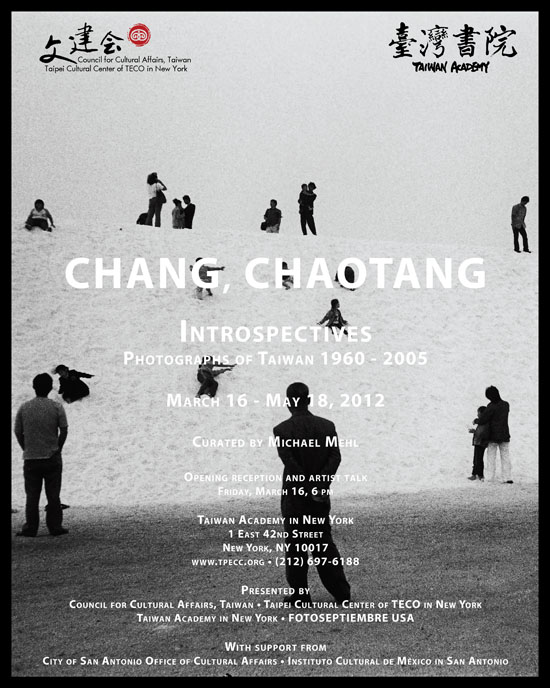
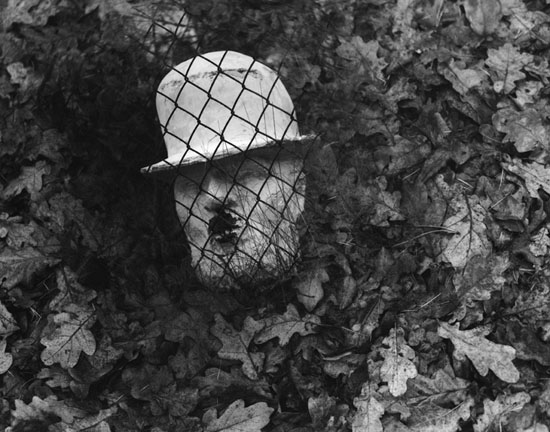
Chang, Chaotang's images are deceptively simple. So is he. Introspectives : Photographs of Taiwan 1960 - 2005, is the third exhibit of Chaotang's photographs I've curated in the span of a year. No mean feat. When I received a compilation of Chaotang's work in early 2011, I took a cursory look at his images and figured that my curatorial efforts would be simple and straightforward; an easy sum of the parts. After a preliminary selection, I realized there were deeper layers of insight that had escaped me. My initial assessment seemed superficial and had missed the mark. I started over, several times. It's not just that Chaotang has a tremendous body of work encompassing more than five decades of image making – a curatorial challenge by any standard; I also had to account for the many facets of his life, his evolution as a person and an artist, his visual language, the arc of his work... it's daunting to curate Chaotang's images into a single exhibit. We presented two exhibits of Chaotang's photographs in our 2011 FOTOSEPTIEMBRE USA Festival, as part of Taiwan's Splendid For 100 celebrations. One at the Instituto Cultural de Mexico in San Antonio, in which the images tended to formal abstractions, and the other at the City of San Antonio International Center, which was more of a historical retrospective. Even so, I knew we were not doing justice to his work. Yet, in eighteen years of producing our festival, we had never presented two concurrent exhibits by the same artist. Chaotang was the exception. For this exhibit at the Taiwan Academy in New York, I made a selection of prints from the two prior exhibits and added a few more to the mix. The title, Introspectives is a composite of introspection and perspective, two essential traits that define Chaotang's distinctive character and his work. The title also reflects his approach to image making: intuitive, thoughtful and unobtrusive, underlined by a perceptive depth and a precise point of view. Chaotang is a master storyteller. He tells street stories, where hot soup is plentiful, gestures abound, and life is at its fullest. His stories are not sequestered in chapters, and they don't cycle neatly into pre-determined finales. They reveal themselves randomly, surreptitiously, as interludes, in flashbacks, with subversive running commentary. Ultimately, it dawns on you that the stories he tells are his own. Speaking of stories, Chaotang has been to the Alamo and has supped on chicken caldo; he has traveled up and down the Texas Hill Country, savoring PoPo's fried chicken in Welfare and juicy ribs at Cooper's BBQ in Llano – two of Texas' hallowed culinary shrines; he has been to Comanche Rock and he has been to Luckenbach, the music capital of Texas. More to the point, he was designated by the City of San Antonio as San Antonio's Cultural Ambassador to the rest of the world. Chang, Chaotang is a true son of Taiwan, no doubt. However, considering his Texas bona fides, Chaotang is as much a Texan as any Texan can be. Michael Mehl Festival Director FOTOSEPTIEMBRE USA-SAFOTO San Antonio, Texas Chang, Chaotang : Introspectives exhibit at the Taiwan Academy in New York. March 16 - May 18, 2012. • Exhibit Documentation • Press Coverage • New Tang Dynasty Television News Segment • Epoch Times 1  • Epoch Times 2  Epoch Times 3 • World Journal  • Sing Tao Daily • Health Today  • ArtLinkArt  UDN Video • Chang, Chaotang : In his words • I started taking photographs because my big brother used to own a camera himself. That was in 1958, and I was in the third year of my junior high school (15 years old). In order to ease the heavy burdens of my homework, I would take this camera with me -maybe as an excuse- to go out and walk around everywhere, purely for fun and relaxation. Not until my college days (1962) did I start to write some serious stuff, and the reason behind this was also to distraction from boredom and the suffocated atmosphere. • At that time not many people owned a camera in Taiwan, and it was extremely expensive to buy films, let alone to develop them. Therefore I always took these early photographs with extreme discretion. There weren’t many of them, and at that time all I can afford was to make the contact sheets -there was no chance to make the actual prints of my photograph at that time. During my university years, I started to have a glimpse of the development in photography and painting outside Taiwan, mainly through Life or Time magazine in my school library. I was not interested in the pictorialist legacy of Chinese photography. What attracted me, and influenced me most, were these avant-garde/modernist/existentialist writers, surrealist painters, absurdist dramatists, and film directors. • I have a very high regard for documentary photographers, but do not want pinpoint myself as one. To be honest, I would rather be a photo essayist, because it gives you more space to develop your own idiosyncratic vision. I like the atmosphere of the vernacular and the plebeian, dislike any strict rules and unreasonable institution, and always want to distance myself from conservative thinking, hypocrisy, and authority. Maybe in some way, my personal philosophy has gradually reflected in these photographs. Is that a political consciousness? • My personal philosophy towards life has remained roughly the same since my college days. If there was any dissatisfaction, I think they all reflect in my works. I believe that agony is one of the main sources for artistic creation. One should use his works to express, to relieve, or to reconcile with his inner bitterness and anguish. Many artists were persecuted by the government before the lifting of martial law in 1987, and things were quite nasty from the 1950s to the 1970s -which was commonly referred as The White Terror era. For a long time, documentary photography in Taiwan was suppressed due to the forementioned political context, but the situation was much better for documentary photography during the 1990s, after the martial law had been lifted. • My concern for the social reality probably originated from my experience of working as a cameraman in a TV station (1968). This gave me a chance to get in touch with all aspects of society, especially the vernacular and the often-ignored lowlife. Later I started to produce news features and documentary films for various channels, and it helped me to relocate my photography focus towards the social reality of everyday life. • I’m deeply fascinated by gestures, and always want to express them through my camera lens. When photographing people, I want to pursue the gestures of emergence and deployment, capturing their life and existence, and thereby unfolding my own gesture of observation and contemplation. Maybe I’m deeply influenced by theatre and film, there are some visual parallels -in terms of visual content and composition style- between my photography works and the so-called film stills. It seems to me that when we’re in motion, capturing the most appropriate and touching moment can be understood as freezing the human gestures of that fleeting instant. Of course, there are always scenes that cannot be photographed. Few years ago I wrote an essay about the gestures that I want to photograph but have no way of conceaving them, such as falling, seizure, vomiting, brawling, or deep in coma. • The traditional idea of beauty seems bogus to me. During the 1960s I was deeply involved with the emerging modernist movement in Taiwan. At that time the localized modernism in literature, painting, poetry, music, and drama had only just begun in Taiwan. Me and my friends had devoured everything that came along with this movement, and tried extremely hard to appropriate and reinterpret it by our own angle and artist vision. I tried to take my photographs differently. I wanted to develop a kind of uneasy strangeness through my photographic imagination for the sake of emphasizing or concealing the subject, that’s why there were so many interplay/interchange of focusing and blurring in my images. • I like some of the aesthetic elements in calligraphy, such as its abstract contour and lines. My recent tendency is to capture visions with minimal elements, but of extensive and tranquil quality. It could be just a few lines which represent the living reality and the feeling of being parts of it. Rarely do we encounter such a scene. • What matters most in photography is one’s intuition. Learning and experience is nothing but a process of basic training in our long life. The act of creating art will change and evolve with one’s life experience and surroundings. I’m not that reckless and sharp as I used to be, and my energy and adventurous spirit has more or less lost their edge. I will gradually adopt a simple mind and calm attitude, so as to face up my photographic works, and what matters most, life itself. Chang, Chaotang March, 2012
• Tomasz Sobieraj in Lódź, Poland

Two Series That Will Change Photography in Lódź? Tomasz Sobieraj made a name for himself during the past few years, presenting his works, namely documentaries and pinhole photography, at several exhibitions, but his greatest achievement was the contribution to the FOTOSEPTIEMBRE USA festival in 2011 where he showed his Banal Objects. Sobieraj was interested in pin-hole photography for a few years of his artistic career, including colour photography which he hybridically combined – or rather tried to combine, since it is rather impossible – with documentary photography. Observing his artistic evolution one could risk saying that he did not take up photography as a follower of tradition or some school of photography but rather as the follower of literature which in his case is very strongly bound with the photographic medium, although it is not an easy problem to analyze. On the basis of his own reflective writing he was building his unique photographic style, either of the prose of life The Colossal Mug of the City or of poetic imagery Banal Objects; he also combined prose and poetry with Enclave. I. The search for an enclave in the tradition of photography and in his own life Among the several series of photographs by Sobieraj his Enclave, divided into four parts, begins with colour pictures taken with a pin-hole camera, pictures in which architecture and the presented scenes have been shown completely out of focus, while thanks to the colour they gain an oneiric character which is characteristic of the kind of imagery wherein the deliberately softened image is made to resemble a vision in a dream. Initially everything in the Enclave is unreal: buildings, staircases, characters, the figure of Christ blessing a gas station. Empty streets and stalls are symptomatic; someone wanders with a stolen dog. In the part shot using a traditional photographic camera the imagery becomes documentary and sharp in its artistic form. The black-and-white reality shows sombre figures, the narration becomes more personal, as if it was a reportage-like dissection of childhood and youth, and then his style imperceptibly seems to move in the direction of the tradition of photography by Eva Rubinstein - it becomes more aesthetic than oneiric and rapacious. The style in this series is candid, although what is at stake here is not its truthfulness or detailed exemplification of concrete everyday or even “banal” events. In my mind these works are associated more with the notion of the revival of the memory of the place and time of given events. A photograph called …where long ago we kissed girls - with the initiation of maturity suggested in the title – is a broadening of a document by existential experience, and this is an important feature not only of this series. By means of their narrative and poetic titles these photographs gain new meanings, they come alive and turn into an epic story about human life and a derelict city. Therefore the artist builds his story “on the ruins of culture and history”. The next part contains photographic illustrations to Robert Frosts’s poem The Lockless Door. Enclave ends with erotic photographs, as if only love could be a deliverance in this phantom-city that is falling apart. The most poetic series focused on the transitoriness and phantasm of vision is The Street of Crocodiles, inspired by the prose of Bruno Schulz. The artist purposefully uses and explores the qualities of black-and-white photography in order to finally blur the contours of reality by means of the fuzziness of individual takes. A pin-hole camera is probably the best of tools to express the problem of another kind of reality which balances on the edge of legibility and credibility but which shows a surrealistically oneiric reality. II. Contemporary but also historical image of the memory of Lódź The focus on the problem of a document, sometimes in its painfully sad aspect, forms the ground for the Colossal Mug of the City. The title of this touching series was borrowed from Polish Flowers by Julian Tuwim, a poet from Lódź. It turns out that such a pessimistic, and sometimes tragical and comical image of Lódź, is still valid. Has the city not changed much through the years or has Sobieraj’s imagination merely selected and employed Tuwim’s images in his own artistic statement? What does the notion of a document mean today? A document is and has always been a presentation of one’s faith in the reality/truth of history or an event which is being illustrated, without any arrangement or staging of presented scenes, conducted in identifiable time and concrete space. Let me stress here that in Sobieraj’s case we do not have to do with a reportage but with a photographic document, which in my opinion is most convincing and honest. Naturally this type of interpretation, realistic, although leaning towards expressionism, may be found in the dark depths of the history of photography. Let me mention here pictures by Jacob Riis, the Farm Security Administration, and later most of all the works by William Klein, Robert Frank and Garry Winongrand, critical towards reality, works by artists who were looking for completely different photography than the tradition of the decisive moment established by Henry Cartier-Bresson. In the historical and still degraded centre of Lódź we can see bleak alleys, uncouth antisemitic slogans written on the walls and people as if from a nightmare – for example “the pigeon eater”. The atmosphere resembles that of Bohumil Hrabal’s The Corpse Burner. This deeply painful image of Lódź is strongly contrasted with advertising billboards that represent Baudrillard’s artificial, commercial “hyper-reality” which belongs more in the myth of Las Vegas or Tokyo, not in this ruined city. Time in Lódź has imperceptibly stopped but it is hard to say when – before or immediately after the war when many of the inhabitants of Litzmannstadt disappeared from their hometown. On the other hand there is more poverty and destitution in contemporary Lódź than in the 1970s or 80s. Sobieraj is a meticulous observer. In this comprehensive series he has portraited his native Lódź at the break of the 21st century when it became one of the most dismal cities in Poland; he showed various aspects of reality, including the dull life of a homeless man pulling his cart, the proverbial Edi (2002) by Piotr Trzaskalski (a director from Lódź, by the way), a rare feature film which came close to the reality of the “truth of being”. A similar image of contemporary Lódź set in the context of the Jewish ghetto and its modern-day inhabitants was also shown in an eminent documentary film by a Czech director Pavel Štingel, entitled The Baluty Ghetto (Ghetto jménem Baluty) from 2008. Sobieraj does not hide the primitive antisemitism in the image of the city, he asks where it comes from and how it can be fought. The theme is not new, it has been undertaken many times, for example in video works (Marcin Nowak) or in painting (Kamil Kuskowski). A vulgar slogan in one of Sobieraj’s pictures is depressing and horrifying: Fuck the rabbis from Aleja Unii. Such disgraceful graffitis can be also found on the walls of the former ghetto since this photograph was taken near Pólnocna Street, and alas, they are not exceptional. Other works in the series are psychological portraits with very meaningful captions: A Morning Cigarette, Street Fighter, A Forty Year-Old Man, His Own Cell, The Mad Hatter or Young Generation, Old Habits. Sometimes we can see a touch of irony which is supposed to change this gloomy picture but a little, for example in the work called Goldfish which is actually a carp, and in certain other pictures – of a man and a dog (Friends) or of people alone. Because of such significant questions posed about the devastated history of the city and its lost identity, and because of the presentation of its antiheroes rather than heroes these works should be considered the most important series about Lódź that came into being after the Second World War. I do not know any such other series of photographs, although one must mention Eva Rubinstein’s sentimental album Lódź – Brief Encounters or photographs of other cities by prominent photographers like Andrzej J. Lech or Bogdan Konopka, who, however, did not penetrate the transhistoric city portrait so deeply and who interpreted it in a different way. III. Banal does not mean “meagre” Banal Objects, which have already been analyzed a few times , are an example of a completely different approach, rather artistic than documentary. What is characteristic for this series? It has neither a definite beginning, nor a developing narrative and spectacular ending. Each work, based on the multiple exposition of the negative, is a symbolic search that is supposed to arrive at the “banal objects” of the title or raise them to the level of value from the chaos of randomness. This method slightly resembles that of Marcel Duchamp but it is used in a completely different way and for a different purpose – it is meant to show that potentially everything is worthy of poetry/photography and whether the work is successful depends only on its creative power. It is also a melancholy or even a catastrophic story which corresponds to the philosophical views held by Witkacy. In this series everything – the objects of everyday use (the material world), the fragmentary world of nature and even religious objects, like a wayside shrine (i.e. also the sphere of metaphysics) – is being degraded and destroyed. The series has a very interesting artistic dimension. Photographing in concrete conditions, the use of grain and flatness of the set brought surprising results that resemble the Surrealist tradition of the 1920s and its oneiric pictures where the real world, broken down into fragments, is permeated with Jung’s prima materia from which archetypes emerge from time to time. In a way these works are also about us, about the games we play, about our physiological habits and physical labour, in spite of the fact that we can only perceive “crumbs of memory”. I have written elsewhere that the style of this imagery and the accompanying ideas comes close to the artistic attitude of Leszek Żurek who is looking for similar emotional states. IV. What does an analogue picture mean? Sobieraj is attached to the photographic analogue image which signifies the equivalent of our perception and the reality of concrete existence – the place and the time, associated only with working with the negative and in the darkroom. As far as creative efforts are concerned he is not interested in the digital image whose essence is its graphic treatment, including the so-called “condensed vision”. In Tomasz Sobieraj’s General Theory of Autumn which represents “surrealistic classicism” the author wrote about an analogue image that “Matter is vindictive, he strongly believed that. Also the so-called inorganic matter – because its lifelessness is but a delusion, and the fact that we naively keep believing in its insensibility and the state of absolute death is merely the proof of our intellectual powerlessness […] and the inability to understand that life can take on extrabiological forms” . In the authorial text called Banal Objects (A Monodrama or a Monologue, As You Like It) , he presented two ways to arrive at art-photography. The first one “[…] appears only when the artist manages to produce a construction of spatial forms and transfer it onto the plane of the frame, depriving the composition fabricated in this way of literalness to the possibly greatest degree” , which might have to do with the approach of a documentalist, while the second one is decidedly more artistic, as Sobieraj wrote: “[…] we isolate a fragment from reality and analyze it. A penetrating study of an object, contemplation, search for essence – this often leads to magnificent artistic results, gives new life to old formulas and forms, sometimes it even makes commonness sacred. Yes, Liu Fa, Six Principles of Chinese Ink Painting works also in the sphere of pure photography” . Sobieraj’s photographic accomplishments are deeply rooted and ontologically domesticated (in the Heideggerian sense of the term) in his literary works. Pointing out these mutual connections and his contemplative attitude towards reality, let me refer to the extremely refined prose by this artist and mention as an example his General Theory of Autumn (2010). In these so different but sometimes adjacent forms of artistic expression the key role is played by the search for “the truth of being” and “the domestication in being” which expresses Sobieraj’s metaphysical attitude towards the world. Krzysztof Jurecki

• Thank You

• City of San Antonio International Center

Chang Chaotang, featured artist, Introspectives : Photographs Of Taiwan 1960 - 2005, City of San Antonio International Center. Introspectives : Photographs Of Taiwan 1960 - 2005, City of San Antonio International Center. Introspectives : Photographs Of Taiwan 1960 - 2005, City of San Antonio International Center. Introspectives : Photographs Of Taiwan 1960 - 2005, City of San Antonio International Center. Introspectives : Photographs Of Taiwan 1960 - 2005, City of San Antonio International Center. Introspectives : Photographs Of Taiwan 1960 - 2005, City of San Antonio International Center. Introspectives : Photographs Of Taiwan 1960 - 2005, City of San Antonio International Center. Introspectives : Photographs Of Taiwan 1960 - 2005, City of San Antonio International Center. Introspectives : Photographs Of Taiwan 1960 - 2005, City of San Antonio International Center. Introspectives : Photographs Of Taiwan 1960 - 2005, City of San Antonio International Center. Introspectives : Photographs Of Taiwan 1960 - 2005, City of San Antonio International Center. Introspectives : Photographs Of Taiwan 1960 - 2005, City of San Antonio International Center. Introspectives : Photographs Of Taiwan 1960 - 2005, City of San Antonio International Center. Introspectives : Photographs Of Taiwan 1960 - 2005, City of San Antonio International Center. Introspectives : Photographs Of Taiwan 1960 - 2005, City of San Antonio International Center. Introspectives : Photographs Of Taiwan 1960 - 2005, City of San Antonio International Center. Introspectives : Photographs Of Taiwan 1960 - 2005, City of San Antonio International Center. Chang Chaotang, Introspectives : Photographs Of Taiwan 1960 - 2005, City of San Antonio International Center. The calm before the storm. Just before the opening reception for the exhibit. Opening reception for Chang Chaotang's exhibit at the International Center. Robert Huesca and Shahrzad Dowlatshahi. Synthia and Kent Nabarrete. Jim Smyle, Rosanne White, and Joan Miller. Fotoseptiembre favorites, Nancy Fullerton and Marilyn Lanfear. Susan Yu, Director of the Taipei Cultural Center in New York, with City of San Antonio District 9 Councilwoman Elisa Chan. Chang Chaotang with Yuli and Min-Tang Chang. Margaret Tengyin Lee and Daniel Lee. Opening remarks in honor of Chang Chaotang and the FOTOSEPTIEMBRE USA 2011 Taiwanese guest artists, by Felix Padron, Director, City of San Antonio Office of Cultural Affairs. Opening remarks in honor of Chang Chaotang and the FOTOSEPTIEMBRE USA 2011 Taiwanese guest artists, by Councilwoman Elisa Chan. Chang Chaotang. The master at work. Councilwoman Chan presenting Susan Yu with an official recognition as a cultural emissary for San Antonio. Councilwoman Elisa Chan and Felix Padron presenting Chang Chaotang with an official recognition as a cultural emissary for San Antonio. Councilwoman Elisa Chan and Felix Padron presenting Isa Ho (Meng-Chuan Ho) with an official recognition as a cultural emissary for San Antonio. Councilwoman Elisa Chan and Felix Padron presenting Cheng-Chang Wu with an official recognition as a cultural emissary for San Antonio. Councilwoman Elisa Chan and Felix Padron presenting Daniel Lee with an official recognition as a cultural emissary for San Antonio. Jim Hu, Felix Padron, Chang Chaotang, Susan Yu, Elisa Chan, Cheng-Chang Wu, Daniel Lee, Isa Ho, and Frank Villani. FOTOSEPTIEMBRE USA 2011 guest artists from Taiwan, Cheng-Chang Wu, Chang Chaotang, Daniel Lee, and Isa Ho (Meng-Chuan Ho). Chang Chaotang, Introspectives : Photographs Of Taiwan 1960 -2005, City of San Antonio International Center.

• Instituto Cultural de México

Chang Chaotang, featured artist, Art & Culture Of Taiwan : Sightlines exhibit, Instituto Cultural de México. Cheng-Chang Wu, featured artist, Art & Culture Of Taiwan : Vision of Taiwan exhibit, Instituto Cultural de México. Isa Ho (Meng-Chuan Ho), featured artist, Art & Culture Of Taiwan : Fairy Tales exhibit, Instituto Cultural de México. Image series by Cheng-Chang Wu. Image series by Cheng-Chang Wu. Image series by Cheng-Chang Wu. Image series by Cheng-Chang Wu. Image series by Cheng-Chang Wu and Isa Ho. Image series by Isa Ho. Images by Cheng-Chang Wu, Chang Chaotang, and Isa Ho. Image series by Isa Ho. Images by Isa Ho and Chang Chaotang. Images by Isa Ho and Chang Chaotang. Images by Isa Ho. Images by Isa Ho. Image series by Chang Chaotang. Image series by Chang Chaotang. Image by Chang Chaotang. Image series by Chang Chaotang. Image series by Chang Chaotang. Image Chang Chaotang and Isa Ho. Art & Culture Of Taiwan exhibit at the Instituto Cultural de México. Jennifer Shaw, featured artist, Hurricane Story exhibit, Instituto Cultural de México. Hurricane Story exhibit by Jennifer Shaw. Hurricane Story exhibit by Jennifer Shaw. Hurricane Story exhibit by Jennifer Shaw. Hurricane Story exhibit by Jennifer Shaw. Images by Jennifer Shaw. Images by Jennifer Shaw. Images by Jennifer Shaw. Images by Jennifer Shaw. Images by Jennifer Shaw. Hurricane Story by Jennifer Shaw at the Instituto Cultural de México. Elise Boularan, featured artist, LookShe : Bémol exhibit, Instituto Cultural de México. Dita Kubin, featured artist, LookShe : Underneath Skin exhibit, Instituto Cultural de México. Malin Vulcano, featured artist, LookShe : Booby Trap exhibit, Instituto Cultural de México. LookShe : Underneath Skin series of images by Dita Kubin. LookShe : Tokyo Hotel Story series of images by Nathalie Daoust. LookShe : Bémol series of images by Elise Boularan. LookShe images by Nathalie Doaust and Malin Vulcano. LookShe : Booby Trap series of images by Malin Vulcano. LookShe exhibit. Images by Elise Boularan. Images by Nathalie Doaust. Images by Dita Kubin. Images by Malin Vulcano. LookShe exhibit, Instituto Cultural de México. Mini Series III exhibits by Alex Dorfsman, Tomasz Sobieraj, and Chris Zedano. Mini Series III exhibits by Alex Dorfsman, Tomasz Sobieraj, and Chris Zedano. Staple Street Project by Chris Zedano. Series of Images by Chris Zedano and Alex Dorfsman. Superficie images by Alex Dorfsman and Banal Objects images by Tomasz Sobieraj. Images by Alex Dorfsman and Tomasz Sobieraj. Images by Alex Dorfsman and Tomasz Sobieraj. A segment of Superficie by Alex Dorfsman. A segment of Banal Objects by Tomasz Sobieraj. Images by Chris Zedano. Mini Series III exhibits by Alex Dorfsman, Tomasz Sobieraj, and Chris Zedano. FOTOSEPTIEMBRE USA 2011 Signature Exhibits opening reception, Instituto Cultural de México. FOTOSEPTIEMBRE USA 2011 Signature Exhibits opening reception, Instituto Cultural de México. FOTOSEPTIEMBRE USA 2011 Signature Exhibits opening reception, Instituto Cultural de México. FOTOSEPTIEMBRE USA 2011 Signature Exhibits opening reception, Instituto Cultural de México. FOTOSEPTIEMBRE USA 2011 Signature Exhibits opening reception, Instituto Cultural de México. FOTOSEPTIEMBRE USA 2011 Signature Exhibits opening reception, Instituto Cultural de México. Jannifer Shaw and Claudia Maceo Sharp, Manager of The Twig Book Shop, promoting Jennifer Shaw's Hurricane Story book at the reception. The Taiwan contingent discussing Isa Ho's images. Chang Chaotang, Cheng-Chang Wu, Felix Padron, Isa Ho, and Gabriela Franco. LookShe artists ready for their close up. Dita Kubin discussing her work at the opening reception. Lorena and Bernardo Ortega. Gary and Nancy Fullerton with Rosanne White. Bob McKinley and Esther Ng. Jennifer Shaw with Michaele and David Haynes. Maria Elena and Richard Mogas with Veronica Prida. Jim Smyle and Joan Miller. Isa ho with Daniel Lee at the opening reception. Chang Chaotang, Jean Hu, Isa Ho, Jim Hu, and Cheng-Chang Wu. Paula Owen, David Rubin, and Gabriela Franco. The Fotowerks Camera Club from the South Texas College in McAllen, with instructor/mentor David Freeman. In the Art & Culture Of  Taiwan exhibit. In the LookShe exhibit. In the Mini Series III exhibit. In the Hurricane Story exhibit. Planking with Chang Chaotang's image. Planking with Isa Ho's images. Planking with Jennifer Shaw's images. Olmec Planking at the Instituto Cultural de México in San Antonio, Texas. Northwest Vista College Photography Class, with Adjunct Professor of Art and Humanities/Artist Deborah Keller-Rihn. Discussing images by the Taiwanese artists in the exhibit. Discussing images by Isa Ho. At the LookShe exhibit. At the Mini Series III exhibit. At the Mini Series III exhibit. Looking at images from Jennifer Shaw's Hurricane Story exhibit. Deborah Keller-Rihn conducting a discussion with her students on the exhibits at the Instituto Cultural de México

• San Antonio Museum Of Art

Daniel Lee, featured artist, Animal Instinct exhibit, San Antonio Museum Of Art. A philosopher and humanist at heart, Daniel Lee has held a longtime fascination with human behavior. In his photographs produced since 1993, Lee has been conducting an ongoing inquiry into questions about what makes us human. Specifically, he is a keen observer of the many parallels that can be found between us homo sapiens and other species. Using computer technology and a vivid imagination, he has produced several photographic series that reveal many of the attributes that we share with our animal compatriots. Born in 1945 as Lee Xiaojing in Chunking, China, Lee was raised in Taiwan and moved to United States after receiving his BFA in painting in 1968 from the Chinese Culture University, Taipei. In 1972 he earned an MA in Photography and Film from the University of the Arts, Philadelphia and, in 1973, he moved to New York City to work as a commercial art director. By the end of the 1970s, Lee had decided to devote his time to being a fulltime artist. Since 1993, he has used computer technology to combine his photographic and fine art skills in a single medium. Animal Instinct is a survey exhibition of Daniel Lee’s photography from 1993-2010. The exhibition begins with examples from the series Manimals (1993), which is based on the ancient Chinese zodiac cycle of twelve animal signs associated with birth years. Using digital technology, Lee creates hybrids of human beings and animals, portraying the idea that a person is believed to exhibit behavioral and personality traits, sometimes even physical characteristics, relative to the animal year during which he or she was born. Also included in the exhibition are several photographic murals. 108 Windows (1996-2003) is related to a Buddhist tradition of ringing 108 bells on special occasions. In Nightlife (2001), Lee’s characteristic hybrid figures are transformed into punk night clubbers. Celebration (2004), from the series Harvest, is an imaginative vision of a future world populated with a breed of livestock that supplies human eyes, hearts, livers and other harvested organs as a means of furthering the human race. Lee’s latest mural, Circus (2010), reveals the symbiotic relationship between humans and animals at its most extreme: animals perform like people, people perform like animals, and audiences retreat into children. The exhibition also includes a print from the series Dreams (2008), which was inspired by a book of short stories, and Origin (1999-2003), a digital animation based on Darwin’s theory of evolution. In keeping with of the tradition of calligraphically inscribing a work’s title and artist’s signature in the lower corner of a Chinese scroll painting, Lee has presented this information digitally on his prints. David Rubin, The Brown Foundation Curator of Contemporary Art, Animal Instinct exhibit curator. Animal Instinct by Daniel Lee at the San Antonio Museum Of Art. Animal Instinct by Daniel Lee at the San Antonio Museum Of Art. Animal Instinct by Daniel Lee at the San Antonio Museum Of Art. Animal Instinct by Daniel Lee at the San Antonio Museum Of Art. Animal Instinct by Daniel Lee at the San Antonio Museum Of Art. Three Yellow Dogs, by Daniel Lee. Origin, video sequence by Daniel Lee. Manimals, by Daniel Lee. Daniel and Margaret Tengyin Lee. SAMA docent explaining 108 Windows by Daniel Lee. Opening reception for the Animal Instinct exhibit at SAMA. Elise Boularan, Isa Ho, Margaret Tengyin Lee, Dita Kubin, Daniel Lee, Cheng-chang Wu, Malin Vulcano, and Jennifer Shaw. Jeffrey Dyer and Jerry Craft, friends of Fotoseptiembre and fans of Daniel Lee's work. Opening remarks at the reception for the Animal Instinct exhibit by Daniel Lee at the San Antonio Museum Of Art. A few days later, A Conversation With Daniel Lee, conducted by exhibit curator David Rubin. A Conversation With Daniel Lee, conducted by exhibit curator David Rubin. A Conversation With Daniel Lee, conducted by exhibit curator David Rubin. Taking questions from the public. Circus, by Daniel Lee, Animal Instinct exhibit, San Antonio Museum Of Art.